


SR&DL at NYIT's Design Intelligence: AI and Critical Futures
Directors of the Synesthetic Research & Design Lab (SR&DL), Loukia Tsafoulia and Severino Alfonso, recently presented the lab's work at the Design Intelligence: AI and Critical Futures symposium, held on April 9 at the School of Architecture & Design at the New York Institute of Technology. The symposium brought together scholars, designers, and technology leaders to critically examine the evolving relationship between artificial intelligence and design practices.
Within a program that addressed creativity, authorship, ethics, and agency in an age of intelligent systems, Tsafoulia and Alfonso shared SR&DL’s ongoing research and design work, highlighting the lab’s commitment to speculative, cross-disciplinary, and critically engaged approaches to computational design. Their presentation underscored design’s role not merely as a user of AI tools, but as an active agent in shaping the cultural, ethical, and imaginative futures of intelligent systems.

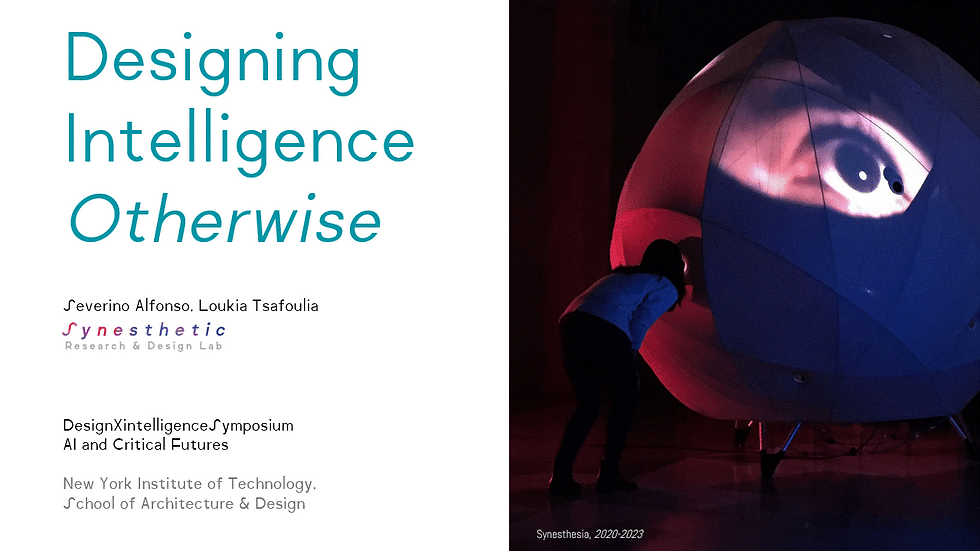
About our presentation: Designing Intelligence Otherwise
Our presentation, Designing Intelligence Otherwise, situates current debates around design and artificial intelligence within a longer historical lineage linking cybernetics, the sciences of the mind, and the design methods movement. Drawing on early cybernetic thinkers—among them Ross Ashby, Grey Walter, Gordon Pask, and Heinz von Foerster—we argue for an understanding of intelligence not as abstract computation or representation, but as embodied, relational, and enacted through feedback, interaction, and care. As AI systems increasingly generate options and predictions, we ask a different question: whose intelligence counts, whose perception is centered, and whose agency is expanded or quietly constrained by the systems we design?
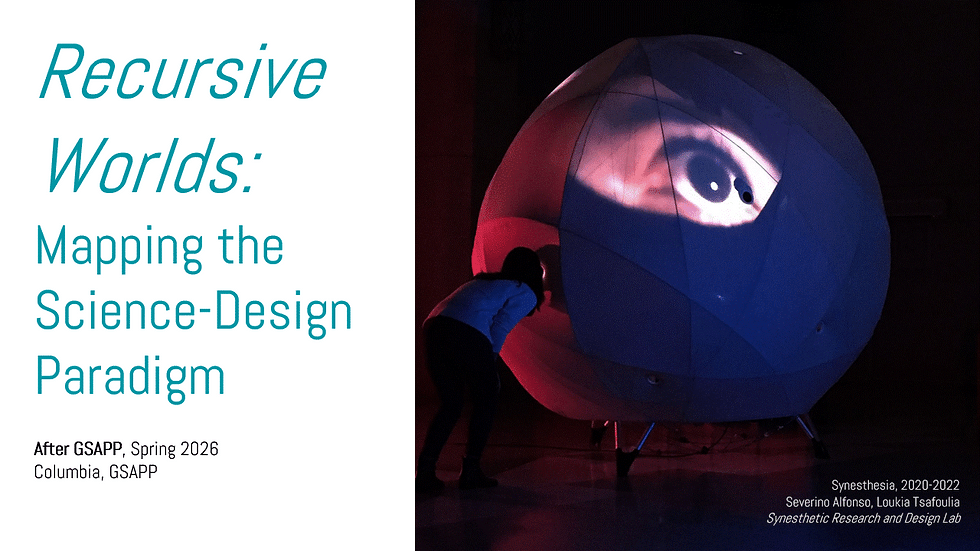
Through a series of research‑driven art and architectural projects—Synesthesia, San Baudelio Revealed, and Echoes—we explore multisensory, responsive environments that resist legibility, coherence, and closure. Informed by embodied and “estranged” phenomenology, these projects do not seek to optimize user behavior or resolve perception, but to support sensory difference, uncertainty, and self‑regulation without demanding comprehension.
We conclude by proposing an alternative model of environmental intelligence in which AI participates as a co‑performer rather than an autonomous decision‑maker. Designing intelligence otherwise, we argue, means cultivating systems that increase meaningful choice, protect agency under conditions of uncertainty, and foreground ethical listening as a core design practice.

Thank you!
Our gratitude goes to Dean Maria R. Perbellini and the New York Tech SoAD Lectures & Events Committee for their vision and support, as well as to the many students whose participation and questions guided the conversations throughout the day. We are especially thankful to the symposium’s moderators, Athina Papadopoulou, PhD, and Alessandro Melis, for their facilitation and guidance.
We would also like to congratulate our fellow presenters for their contributions:
Alexandros Haridis, Lecturer in Design Computing, Harvard University
Onur Yüce Gün, PhD, Director of Computational Design, New Balance
Charles Portelli, FAIA, RIBA, CDT, Digital Innovation Strategist and Computational Designer, Perkins & Will
Heather Ligler, Assistant Professor, Florida Atlantic University
Diego Pinochet, Computational Designer

Comments