


Our Latest Talk at Columbia GSAPP — From Theory to Embodied Practice
On February 4th, Loukia Tsafoulia and Severino Alfonso Dunn presented their research and SR&DL creative work at the Graduate School of Architecture, Planning, and Preservation at Columbia University in New York.
Deep gratitude to Lydia Kallipoliti and Marc Tsurumaki for the generous invitation and the thoughtful, critical questions that enriched the discussion. Thank you to Ben Weisgall for the contextual introduction to our research and for guiding such a sharp conversation, and to the GSAPP students and community for the insightful questions and engaged presence. What an honor to return and reconnect with this remarkable intellectual community!
SR&DL Presentation at GSAPP, February 2026 @ Wood Auditorium.
Our lecture traced a personal and intellectual trajectory- Beginning with a biographical arc from the European polytechnic tradition to Columbia’s Advanced Architectural Design program, it moves deliberately back and forth between history/theory and practice, using design research projects as active “interruptions” that test—and reframe—the ideas being discussed.
The talk traced how cybernetics and the sciences of the mind shaped design culture—from mid-century experiments in feedback and adaptive behavior to the design methods movement and the later evolution of design thinking. These historical threads opened into the embodied turn, where perception is understood as enacted, situated, and inseparable from bodies moving through environments. From there, the lecture turned to work from our lab, the Synesthetic Research and Design Lab (SR&DL), where sensor technologies and responsive systems serve as tools for materializing experience.
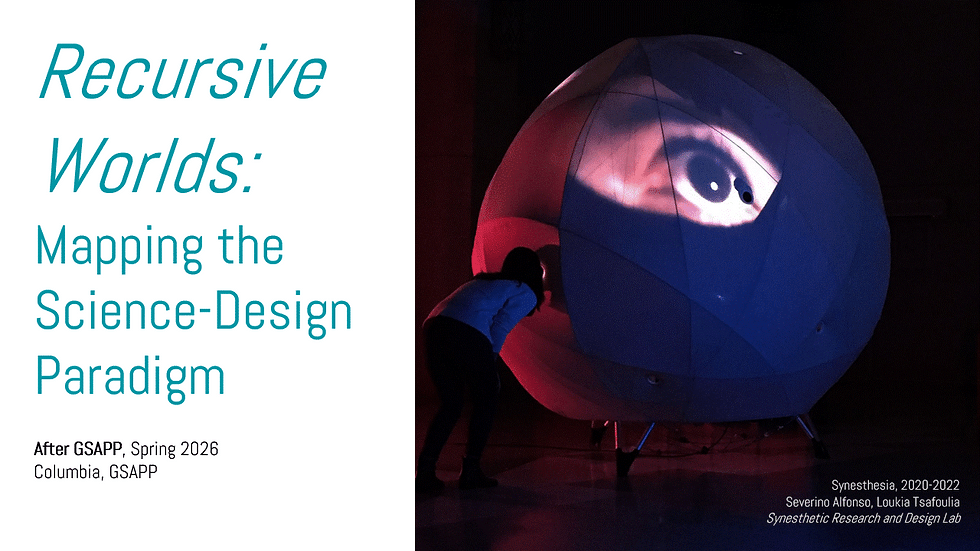
Four projects anchored the talk: Synesthesia, a multisensory installation structured through interaction and feedback; San Baudelio Revealed, a full-scale, sensorially augmented investigation of a medieval hermitage and the migration of its “aura”; and the interconnected works of Echoes multimodal environment and the Voices film documentary, which examine sensory urban life—especially sound—through collaboration with autistic participants, researchers, and self‑advocates. Together, the projects interjected histories and theories into lived, experiential practice, framing design as a mode of inquiry, care, and alternative imaginaries.
A glimpse of the presentation:

Comments